Searching for Certainty in an Uncertain Form of Writing
- 4月2日
- 讀畢需時 2 分鐘
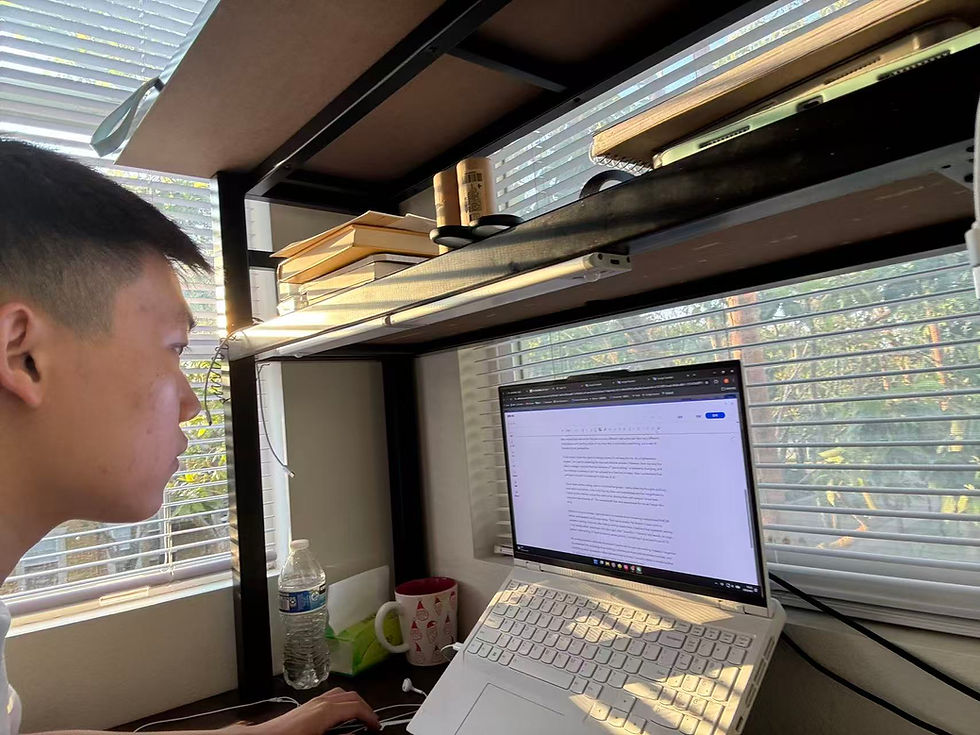
Working on this blog at my desk
As an international student from
China, after almost two years of taking writing classes at UCI, I can‘t say that my skills have improved dramatically, but I have definitely been exposed to very different approaches to writing. Beyond the obvious differences between Chinese and Western writing styles, I have also noticed that even within the same course, different instructors can have very different expectations and teaching styles. In my view, this is not totally a bad thing, but a way of broadening my perspective.
To be honest, these two years of writing classes it's not easy for me. As a mathematics student, I am used to searching for clear and definite answers. However, from my very first class in college, I realized that the standard of “good writing” is constantly changing, and the methods to achieve it can't be reduced to a fixed set of steps. Now I understand that perhaps it shouldn't be reduced in that way at all.
I have never written a blog, even in my native language. I rarely share my thoughts publicly, even within my friends. I often feel that my ideas and experiences are too insignificant to matter on the internet, and at the same time, sharing them with people I know feels somewhat like showing off. This creates both fear and expectance for me as I begin this blog.
Before coming to college, I participated in a mathematical modeling competition(HIMCM) where I anticipated in a 25-page essay. That was probably the closest I have come to academic writing. However, after taking writing classes here, I realized that academic writing is not exactly what I expected—it is less rigid, less “scientific.” I tend to rely heavily on logic before I start writing. If I had to rate my writing ability, I would say it is around 6 out of 10.
My writing process is relatively structured. I prefer not to rush into writing. Instead, I organize my materials first, including close reading, collecting primary and secondary sources, and identifying useful quotations. After determining my thesis, I usually create a simple outline to make sure I stay on track. Logical clarity is very important to me.
Personal Theory of Justice
As for my personal theory of justice, I do not believe justice is a universal and objective standard. Instead, I see it as an internal judgment within each individual. It is reflected in whether a person intentionally harms others, which makes it closer to the idea of “conscience” rather than an external system of rules.
In terms of whom justice includes, I believe it applies to every self-aware individual. However, whether it actually functions depends on whether a person chooses to restrain themselves. Therefore, justice only truly exists in those who actively practice self-restraint.
If this view of justice is successful, it does not create a perfectly fair society. Instead, it creates a condition in which people choose not to harm others, even when they have the ability to do so. In such a society, order is not maintained by absolute justice, but by the self-discipline of individuals, which prevents complete chaos.


留言