Yichen Cui
A Human-Made Crisis:
Why Coyotes Have Adapted to Cities
The first time I saw a coyote standing near a trash area late at night, I expected it to run. Instead, it paused under the dim light, looked back at me for a moment, and slowly walked away. My first reaction was confusion: Why wasn’t it afraid of me? At first glance, encounters like this can make it seem as if coyotes are suddenly invading human spaces. However, the story is more complicated than a simple wildlife invasion. Rather than coyotes simply moving into cities, humans have dramatically reshaped the environments coyotes depend on, forcing them to survive in landscapes increasingly built around people rather than wildlife.

Figure 1. A coyote walks through a residential area in Southern California. Encounters such as this often appear to be evidence of a wildlife “invasion,” but they are more accurately understood as the result of habitats increasingly reshaped by human development. (Photo by author.)
As urban expansion fragments habitats and human food becomes easier to access, coyotes have adapted in ways that help them survive near people . Over time, many urban coyotes become bolder, more flexible, and less fearful of human activity that are often necessary for survival in cities. Yet the same adaptations that help coyotes survive can also place them in greater danger, increasing the risk of vehicle collisions, conflict with humans, and lethal removal from urban environments.
To understand why coyotes increasingly appear in urban neighborhoods, it is important to examine how humans have transformed the landscapes they once occupied. Seth Riley, a wildlife ecologist with the National Park Service, found that urban development in Southern California fragmented once-continuous habitats as Figure 2 illustrates, roads and other forms of infrastructure can divide once-connected habitats into isolated patches, forcing wildlife to move through increasingly human-dominated environments. Instead of moving freely across connected landscapes, coyotes are increasingly forced to navigate human-dominated environments to find shelter, mates, and food.
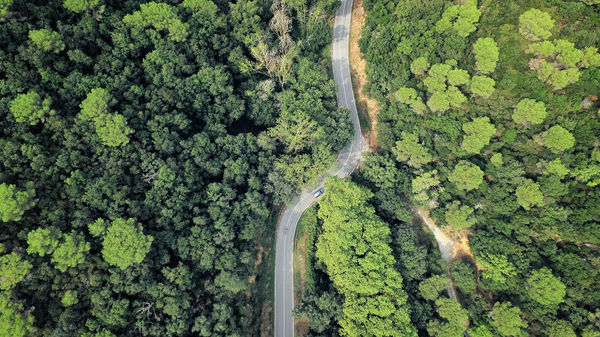
Figure 2. Urban development has fragmented once-connected habitats into isolated patches, forcing coyotes and other wildlife to navigate roads, neighborhoods, and other human-dominated environments.
Urbanization also changed what food looks like for coyotes. In cities and suburban neighborhoods, resources such as overflowing trash bins, pet food, fallen fruit, and rodents living near human structures create new opportunities for survival. Rachel N. Larson, a wildlife researcher who studies urban carnivores in Southern California, found that human-associated food sources made up a significant portion of some urban coyote diets, suggesting that city environments are not simply places coyotes pass through, but places where they actively adapt to survive. In other words, urban coyotes are not just responding to habitat loss—they are learning to live within a human-shaped environment .
Living near people requires a different set of survival skills. A rural coyote that reacts too slowly to danger may not survive, while an urban coyote that runs from every sound, person, or passing car may struggle to find food or navigate the city efficiently. Stewart Breck, a research wildlife biologist with the USDA National Wildlife Research Center, found that urban coyotes behave differently from their rural counterparts. Compared with coyotes living in less developed areas, urban coyotes tend to be bolder and more willing to explore unfamiliar environments. Rather than immediately fleeing, some urban coyotes pause, observe, and assess whether a human actually poses a threat. In retrospect, the coyote I encountered near the trash area may not have been unusually fearless at all; it may simply have been exhibiting the same adaptive behavior Breck observed in urban populations. Such behavior did not emerge in isolation, but in response to environments increasingly shaped by human development.
Part of what makes this adaptation possible is the coyote’s remarkable behavioral flexibility. Julie Young, a behavioral ecologist at Utah State University, found that coyotes improve their problem-solving abilities through persistence and by observing the behavior of other coyotes. In rapidly changing urban environments, this flexibility allows coyotes to adjust their behavior, find resources, and respond to unfamiliar situations more successfully than many other predators. Figure 3 demonstrates the extent to which urban coyotes already move through neighborhoods, roads, and commercial areas rather than remaining confined to isolated natural habitats.
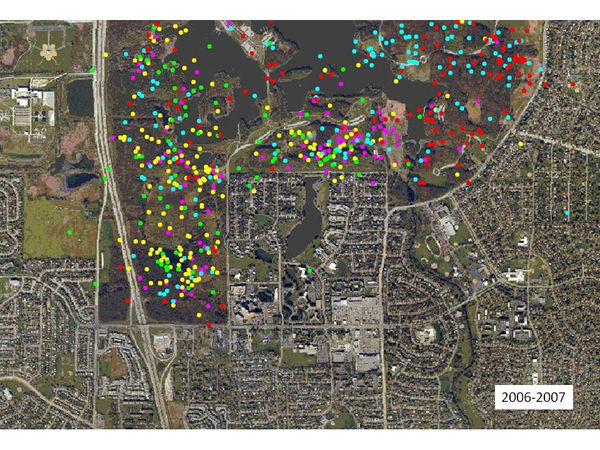
Figure 3. GPS locations of urban coyotes tracked in the Chicago metropolitan area between 2006 and 2007. The distribution of points demonstrates that coyotes routinely move through neighborhoods, roads, and commercial areas rather than remaining isolated within natural habitat.
As repeated encounters with humans become more common, many coyotes also undergo a process known as habituation, gradually becoming less fearful of human presence over time. Importantly, less fear does not necessarily mean aggression. In many cases, habituation simply means a coyote has learned when humans are harmless and when they should still be avoided. Yet this growing tolerance often creates misunderstanding, as people may interpret calm or curious behavior as threatening rather than recognizing it as a response to human-altered environments.
The same adaptations that help coyotes survive in cities can also place them in greater danger. For a coyote, urban life is filled with risks that did not exist in the same way in more natural environments. Roads, traffic, fences, and constant human activity turn the city into a landscape that is both full of opportunity and increasingly dangerous. Stanley Gehrt, a wildlife ecologist and director of the Chicago Urban Coyote Project, found that vehicle collisions were the leading cause of death among radio-collared coyotes in the Chicago metropolitan area, accounting for approximately 62% of recorded mortalities, while another 18% were caused by shootings. Even coyotes that actively avoid humans are still vulnerable when fragmented habitats force them to cross highways or move through heavily developed areas.
Yet physical dangers are only part of the problem. As coyotes become more comfortable living near people, encounters with pets, backyards, or neighborhoods often trigger fear among residents. A coyote calmly walking through a neighborhood may be seen not as an animal adapting to urban conditions, but as an immediate threat. According to Breck et al., public concerns about safety frequently pressure wildlife agencies and local communities to adopt lethal control measures, including trapping or killing coyotes believed to be responsible for conflict. Ironically, the behaviors that help coyotes survive around humans, such as reduced fear, exploration, and flexibility, can also make them more likely to be targeted by humans.
However, killing coyotes rarely solves the underlying problem. Breck et al. argue that removing resident coyotes often creates space for new individuals to move in, while the urban conditions attracting coyotes—food availability, fragmented habitats, and human development—remain unchanged. In this sense, lethal removal acts more like a temporary response than a lasting solution. If killing coyotes does not address the root causes of conflict, then the more important question becomes not how to eliminate coyotes, but how humans and coyotes might coexist in the same environment.
If urban coyotes are adapting to a world reshaped by humans, then solving conflict requires changing that world as well. The problem facing urban coyotes is not simply that they have become “too bold” or too comfortable around people. As Riley's research on habitat fragmentation suggests, much of the conflict between humans and coyotes begins with fragmented habitats, disrupted movement routes, and urban spaces that force wildlife into closer contact with people. Because the roots of this issue are embedded in the way humans design cities, long-term solutions must address the landscape itself rather than simply reacting to conflict after it happens.
Introduced by Representative Don Beyer in 2026, the Wildlife Corridors and Habitat Connectivity Conservation Act seeks to reconnect fragmented habitats by creating a national framework for wildlife corridors and habitat connectivity. The legislation is designed to help wildlife move safely between habitats, migrate, and adapt to changing environmental conditions. In this sense, it addresses one of the core problems facing urban coyotes: cities often interrupt the pathways wildlife once used to move through their environment.
The value of habitat connectivity becomes easier to understand through projects already taking shape in California. The Coyote Valley Wildlife Crossing Project, a habitat connectivity initiative led by conservation organizations and public agencies in South Santa Clara County, provides a real-world example of how habitat connectivity can reduce both wildlife-vehicle collisions and human-wildlife conflict before they escalate. In Coyote Valley, wildlife attempting to move between the Santa Cruz Mountains and Diablo Range—two of the region’s most important wildlife habitats—must navigate a dangerous combination of highways, rail lines, and major roads that divide natural habitat. As Figure 4 shows, Highway 101 and other forms of development create significant barriers between these habitats, highlighting why wildlife connectivity projects are necessary. Instead of waiting for collisions or neighborhood conflict to occur, local agencies are investing in wildlife crossings, fencing, and protected movement routes that allow animals to travel more safely across developed land.
Figure 4. The Coyote Valley corridor reconnects habitats separated by Highway 101, rail infrastructure, and surrounding development. By preserving wildlife movement routes, habitat connectivity projects can reduce fragmentation, lower the risk of vehicle collisions, and help prevent future human–wildlife conflict.

This approach directly responds to one of the most serious risks identified in urban coyote research: vehicle mortality. According to Gehrt's research on urban coyotes, vehicle collisions account for roughly 62% of documented coyote deaths in some metropolitan regions. Rather than forcing wildlife to repeatedly risk crossing busy highways, habitat corridors create safer pathways that reduce both animal deaths and risks for human drivers. More importantly, they address the conditions that create conflict in the first place by reducing the likelihood that wildlife will be forced into close contact with people.
Habitat connectivity may not eliminate every source of human–wildlife conflict, but it offers benefits that extend beyond coyotes alone. According to the San José Spotlight report on the Coyote Valley corridor, the project is intended to support movement for a wide range of species, including mountain lions, bobcats, badgers, and other wildlife that depend on connections between the Santa Cruz Mountains and Diablo Range. By reducing habitat fragmentation, wildlife corridors can help decrease road crossings, lower the risk of vehicle collisions, and create safer movement routes across developed landscapes. Rather than forcing a choice between human interests and wildlife conservation, projects such as Coyote Valley demonstrate how habitat connectivity can create benefits for both.
Large-scale policies such as wildlife corridors and habitat restoration may offer long-term structural solutions, but legislation alone cannot change public attitudes toward urban coyotes. Because public fear and misunderstanding often shape how communities respond to wildlife conflict, improving public awareness is just as important as changing the landscape itself. Yet in the age of social media, raising awareness is more complicated than it first appears.
Platforms such as X, Instagram, and TikTok have lowered the barrier for people to access scientific information about wildlife. Educational organizations, researchers, and conservation groups can now share information directly with the public rather than relying entirely on traditional media outlets. In theory, this accessibility should make it easier for people to understand why coyotes appear in neighborhoods and how coexistence strategies can help reduce conflict.
However, personal experience suggests that access to information does not necessarily mean people pay attention to it. During a week-long advocacy campaign on X focused on urban coyotes, posts explaining research on coyote behavior, coexistence, and urbanization often reached relatively small audiences. Even organizations such as Project Coyote, which focus specifically on coexistence education, often receive limited engagement on research-based posts. In practice, social media appears to reward topics that feel immediate, emotional, or personally relevant, while broader ecological problems struggle to sustain public attention.
This limitation does not mean social media is ineffective. Rather, it suggests that social media works best as a tool for amplifying existing concerns rather than generating sustained public interest on its own. Public conversations around coyotes often become most visible only after dramatic events involving pets, neighborhood encounters, or perceived safety risks. While this pattern may be frustrating, it also reveals an opportunity: accessible scientific communication can help shape how people interpret those moments when they happen.
In this sense, grassroots advocacy may be most effective not when it tries to “go viral,” but when it helps communities better understand wildlife before conflict escalates. Sharing practical coexistence strategies, correcting misconceptions about coyote behavior, and making scientific research easier to understand can gradually influence how residents respond to urban wildlife. Although a single post is unlikely to change public policy, broader awareness may help build the public support necessary for long-term conservation efforts such as wildlife corridors and habitat protection.
Despite their potential benefits, large-scale habitat restoration projects often face political and financial obstacles. The Coyote Valley wildlife corridor has experienced delays and funding uncertainty despite being recognized as an important ecological connection for wildlife movement. Because habitat connectivity projects require substantial investment while offering few immediate economic benefits, they can be vulnerable to postponement, budget reductions, or shifting political priorities.
Yet failing to reconnect fragmented habitats may create even greater problems over time. As Riley's research on habitat fragmentation suggests, when wildlife lose safe routes between natural spaces, they are often pushed deeper into urban areas in search of food, shelter, and territory. These conditions increase the likelihood of conflict between humans and coyotes. In this sense, investing in habitat connectivity is not only about protecting wildlife, but also about reducing future human–wildlife conflict before it becomes more severe. If humans helped create the environments that pushed coyotes into cities, then humans also share responsibility for creating spaces where coexistence becomes possible.
Reference
Breck, Stewart W., et al. “The Intrepid Urban Coyote: A Comparison of Bold and Exploratory Behavior in Urban and Rural Coyotes.” Scientific Reports, 2019.
Breck, Stewart W., et al. “Evaluating Lethal and Nonlethal Management Options for Urban Coyotes.” Wildlife Society Bulletin.
Gehrt, Stanley D., et al. “A Long-Term Assessment of Urban Coyote Ecology.”
Larson, Rachel N., et al. “Urban Resources Influence Coyote Diets and Behavior in Southern California.” PLOS ONE, 2020.
Riley, Seth P. D., et al. “Effects of Urbanization and Habitat Fragmentation on Bobcats and Coyotes in Southern California.”
Young, Julie K., et al. “Persistence and Conspecific Observations Improve Problem-Solving Abilities of Coyotes.”
Open Space Trust. “Coyote Valley Wildlife Crossing Project.”
San José Spotlight. “Wildlife Corridors Planned in South County’s Coyote Valley.”
United States Congress. “Wildlife Corridors and Habitat Connectivity Conservation Act of 2026 (H.R. 8438).”