Yichen Cui
Social Media Campaign (SMC):
Research, Education, and Advocacy on X
Throughout this quarter, I used X not only as a social media platform but also as a research and advocacy tool. One of the goals of the course was to explore how we can use social media to start conversations about environmental and animal issues. By following researchers, conservation organizations, and advocacy groups, I was able to see how scientific information is translated into public education and activism.
Using X also helped me understand the strengths and limitations of social media advocacy. While social media allows organizations to quickly reach large audiences, engagement often depends on public interest, algorithms, and the way information is presented. Through my own campaign about urban coyotes, I learned that raising awareness online requires more than simply sharing information; it requires creating content that people are willing to interact with and share.
Click any image on this page to view the original post, article, or source material.
Two Important Tweets from the Quarter

I selected this tweet because it represents one of the most important lessons I learned during the quarter: successful wildlife management is not always about removing animals. Research suggests that education and coexistence strategies can reduce conflict between people and coyotes more effectively than fear-based responses. Before beginning my research, I viewed coyotes primarily as potential sources of conflict. Through studying scientific literature and advocacy organizations, I learned that many conflicts are connected to human behavior and can often be prevented through community education and responsible practices.
Two Recommended Organizations

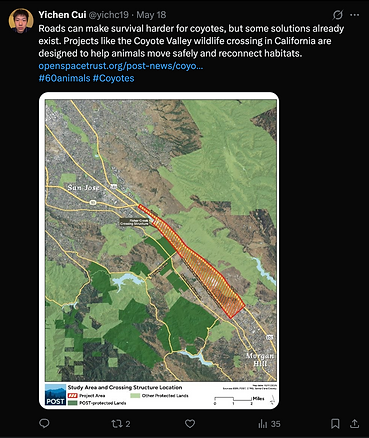
This tweet focuses on one of the major challenges facing urban coyotes: habitat fragmentation. Through my research, I learned that roads and urban development can divide wildlife habitat into isolated patches, making it more difficult for animals to find food, mates, and safe migration routes. I chose this tweet because it highlights a practical solution—the Coyote Valley wildlife crossing in California—which became an important example in both my Social Media Campaign and Advocacy Project. Through this process, I gradually understand how conservation organizations use social media to connect scientific research with real-world policy and infrastructure projects.

The California Department of Fish and Wildlife is a government agency responsible for managing wildlife and natural resources throughout California. I found their website and social media accounts especially useful because they provide practical information that ordinary residents can apply in everyday situations.
This post discusses legal questions related to wildlife management, including coyotes. Although it is not a traditional advocacy post, it demonstrates how government agencies use social media to educate the public and clarify wildlife regulations.
May be effective wildlife advocacy is not only about raising awareness. It also involves providing clear, accurate information that helps people make informed decisions when interacting with wildlife.
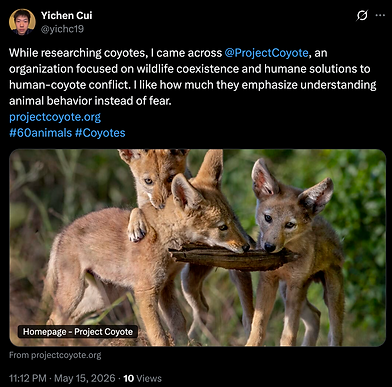

Project Coyote is a nonprofit organization dedicated to promoting coexistence between people and wildlife. Unlike approaches that focus primarily on removing animals, the organization emphasizes education, public awareness, and humane solutions to conflict.
This post promotes Coyote Awareness Week, an outreach campaign designed to educate the public about coyotes and encourage compassionate coexistence. The campaign uses social media to increase visibility, share educational resources, and build community engagement around wildlife conservation.
Project Coyote helped me understand how nonprofit organizations use storytelling, awareness campaigns, and educational content to influence public attitudes.
Problems Facing Urban Coyotes
One objective of my Social Media Campaign was to educate audiences about the challenges coyotes face in urban environments. Through my research, I discovered that many public perceptions about coyotes differ from what scientific studies actually show. I hope through these posts can translate research findings into short, accessible messages for a general audience.

I wrote this tweet because it challenged a common misconception about coyotes. Before beginning my research, I assumed that most conflicts involved direct threats to humans. However, Wilkinson's studies suggest that conflicts are more likely to involve pets, particularly cats and small dogs. This tweet helped me communicate the idea that public fear is not always supported by evidence.
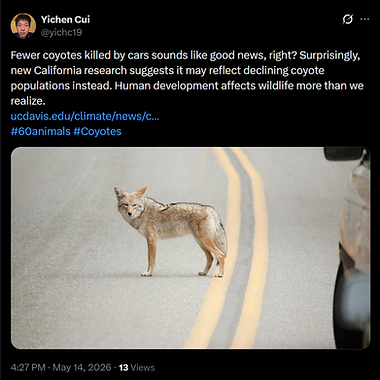
I want this tweet to focuses on a less obvious consequence of urbanization. While fewer reported vehicle collisions may appear to be positive, researchers from UC Davis suggest that declining roadkill numbers can sometimes reflect declining wildlife populations rather than improved conditions. Human development can affect wildlife in complex ways that are not immediately visible. Understanding environmental problems often requires looking beyond surface-level observations and examining the broader ecological context.
Solutions for Human–Coyote Coexistence
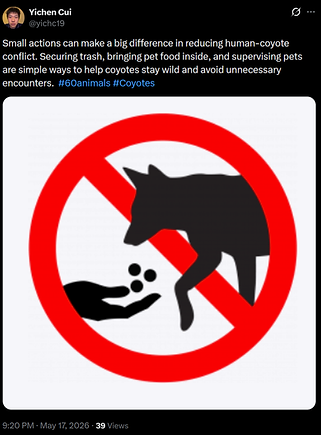
I hope this tweet can focuse on practical actions that people can take immediately to reduce human–coyote conflict. Previoous research consistently shows that unsecured trash, outdoor pet food, and unattended pets can attract coyotes into residential areas. By addressing these attractants, communities can reduce encounters while allowing coyotes to remain wild.

Coexistence begins with understanding. Scientific researchers and advocacy organizations consistently emphasize that by disseminating knowledge about coyote behavior within communities, it is possible to alleviate public fear, optimize decision-making processes, and avert unnecessary conflicts. While institutional frameworks and legal measures can go a long way toward preventing problems, only a genuine understanding—stemming from within—can truly resolve them.
Infographic: Coyotes in Cities – Challenges and Coexistence

This infographic summarizes the central argument of my Social Media Campaign: urban coyotes are not simply a wildlife problem, but a consequence of the ways humans reshape and manage urban environments. The top row highlights several challenges coyotes face in cities, including habitat fragmentation, traffic, and increased access to human food sources. The bottom row presents potential solutions, such as securing food attractants, building wildlife crossings, and promoting public education about coyote behavior.
I intentionally kept the design concise because I personally prefer information-dense formats that bring key ideas together in one place. Rather than presenting every detail, the infographic serves as a summary of the major challenges and solutions discussed throughout my research. I also designed it so that it could be expanded in the future through hyperlinks attached to different sections, allowing readers to explore specific topics in greater depth. In that sense, the infographic functions not only as a visual aid but also as a directory that organizes and connects the main ideas of the project.